On Pathologising Menopause
TLDR: Menopause is a life transition, not a diagnosis. The physical changes deserve support (herbal, nutritional, MHT, or all of the above). But the story we’ve been told about this stage, one of decline and loss, impacts our experience of the transition and has been formed as a way to control and diminish the ageing women.
Over the last few years I have seen many women in their 40s and 50s, seeking help for a wide variety of health issues. Even though the concerns they bring in vary, there is always a common theme – a fear of declining hormones.
It’s often something they bring up indirectly, but I can tell that it’s at the forefront of their mind. That’s not uncommon – many of my patients will list their concerns, but the last thing they mention is often what holds the most weight for them. In terms of hormonal concerns, sometimes it’s about the impact on their sleep, their patience, or they feel like their body is holding onto weight like it’s about to enter hibernation. Sometimes it isn’t about anything specific at all. Just a heaviness. A sense that the light is shifting, and not in their favour.
Walk past any herb garden in late spring and you’ll see the same kind of turning. The sage has bolted into purple flower, the calendula is curling into seed, and the soft new growth of a few months ago has given way to something rangier and more purposeful. Nobody looks at a sage plant in full bloom and calls it a plant in decline. We admire the beauty in this stage of its life, and acknowledge that like all living things, there are stages of growth.
However when it comes to our health and the impacts on how we feel, this acceptance and admiration is not always there. Which is why so many women begin thinking about MHT (menopausal hormone therapy, previously known as HRT – hormone replacement therapy). Not as one helpful tool among many, but as a way to stay exactly where they are. To keep the garden in permanent spring.
And I understand the pull. When the only story you’ve been handed about this stage of life is one of loss and decline, of course you want to stop the clock. But I’ve started to wonder whose story that actually is, and whether it was ever ours to begin with.
···
How a life stage became a disease
For most of human history, menopause simply happened. Women stopped bleeding, and life went on. In many cultures it marked a shift in status, often upwards: the older woman became the elder, the advisor, the keeper of knowledge (and blessedly, excused from some of the domestic load).
Western medicine had other ideas. In the 19th century, doctors wrote about “climacteric insanity” and blamed the ovaries for everything from melancholy to moral weakness. By the 1960s, the bestselling book Feminine Forever framed menopause as an oestrogen deficiency disease, something to be prevented, treated and ideally erased. The language shifted from transition to failure: ovarian failure, oestrogen deficiency.
Contrast that with cultures such as Japan, where anthropologist Margaret Lock found that kōnenki was traditionally understood as a gradual life transition, and women reported hot flushes far less often than their Western counterparts. Same biology, very different story. And the story matters more than we give it credit for.
···
The unveiling
Mood changes usually sit near the top of the list of menopausal “symptoms”. This can look like irritability, rage that arrives ‘out of nowhere’, teariness, frustration and anxiety.
But I’d gently suggest that not all of it comes out of nowhere.
For many women, midlife is when decades of swallowed words start rising to the surface. The resentment of always being the one who carries the mental load of the household whilst still trying to build a career (amidst many possible pauses due to family responsibilities), plus dealing with the many facets of gender bias in society like pay differences, the disrespect we often receive, and the pressure to fit in and appear to be youthful and attractive. Perimenopause doesn’t always create these feelings, but it can mean that we are less likely to hold our tongues about it.
Both things can be true at once. Oestrogen plays a role in how we make and use serotonin and GABA, our mood stabilising and calming messengers. As levels fluctuate, our threshold for holding things in drops. So the grievance is real, and so is the neurochemistry. This is also why the coping strategies that carried you through your thirties may suddenly stop working. The morning coffee, the late night scroll to decompress, the “I’ll just push through”, the glass of wine to take the edge off. If you’ve reached out for help and been given the same advice you got at 30, it’s no wonder it isn’t cutting it. This stage needs its own approach.
···
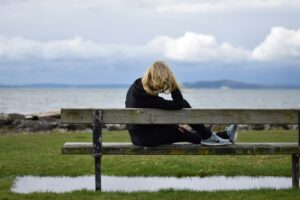
Photo by Jacki Drexler on Unsplash
It’s not just hormones
Which brings me to the other half of the pathologising problem. When we do medicalise perimenopause, we tend to shrink it down to a single factor: oestrogen.
But hormones don’t operate in a vacuum. Mitochondrial function, inflammatory load, blood sugar regulation and nervous system health all shape how smoothly (or chaotically) we move through this transition. Which raises a chicken or egg question. Did years of blood sugar rollercoasters, chronic stress and simmering inflammation make the hormonal shift rockier? Or did the falling hormones knock those systems off balance?
The honest answer is both, in a loop. Declining oestrogen affects insulin sensitivity, energy production in our cells and how resilient we are to stress. And a body already running on empty has far less capacity to adapt when the hormones start to shift. Two women with similar hormone levels can have completely different experiences, because the terrain they bring into perimenopause is different.
That’s actually good news. It means there’s so much more we can work with than one hormone.
···
Maiden, mother, crone
Many traditions describe a woman’s life in phases, and the idea is older than you might think. In ancient Greece, Hera was worshipped at Stymphalos in three forms: as girl, as wife and as widow. Hecate was often shown with three faces, and the three Fates spun, measured and cut the thread of every life between them. In Irish myth, the Morrígan often appears as three sisters.

Hecate as a triple goddess, Louvre Museum. CC BY-SA 2.0, via Wikimedia Commons.
The tidy trio of maiden, mother and crone is more recent. It was popularised by the poet Robert Graves in The White Goddess in 1948, then embraced by the women’s spirituality movement of the 1970s and 80s (proof that an archetype doesn’t need an ancient pedigree to be useful).
The crone got the worst press of the lot. Hag, witch, old bat. It’s worth asking why. An older woman who no longer needs approval, no longer has her energy tied up in bearing and raising children, and has stopped putting up with nonsense is, historically, a difficult woman to control. Making her ugly and frightening was a very effective way to make sure nobody listened to her.
But in the older stories, the crone holds the most power of all. She is the wise woman, the one who has seen enough seasons to know what actually matters.
In the mother phase (whether or not you have children), energy flows outward. We pour into children, partners, parents, workplaces and communities, often until the cup is scraping dry. The crone phase invites that energy to turn inward. To fill our own cup for once. To channel it into creativity, into the projects that were shelved, into rest, or into wisdom. Because boundaries tend to firm up at this stage, the energy vampires that are all too prevalent in the world find slimmer pickings. (Unsurprisingly, they’re not thrilled about it, which may be part of why society keeps tying a woman’s worth to the maiden and mother years.)
···
Dipping your toes in both worlds
I acknowledge I have gone on more of a feminist notion so far, so I will make my point. We should not have to view the very natural phase of life that is menopause as a state of decline or deficiency which can only be remedied with MHT. The attitude that we have towards ageing and menopause is one of the biggest determinants of how it is experienced, and this includes not only our own attitude, but also that of society.
That said, this does not mean we should be gritting our teeth through severe menopausal symptoms such as anxiety, depression or hot flushes in the name of spiritual growth. Embracing this stage and supporting your body through it are not mutually exclusive.
In clinic, I see so many women who simply don’t know how many options there are to support them through this transition. Good support isn’t only about shifting how we see menopause. It’s also knowing when to reach for natural options, conventional ones, or both. Herbal medicine, nutrition, nervous system support and MHT all have their place, and for many women a combination works best.
The way I think about it is this: understand the mechanisms at a physical level, and view the process from a higher, energetic one. Look after your mitochondria, blood sugar levels, nervous system and gut health, and your hormones will feel the benefit. And at the same time, let go of the idea that this is the beginning of the end.
It might just be the beginning of the part where you get to be yourself.
Want to go deeper?
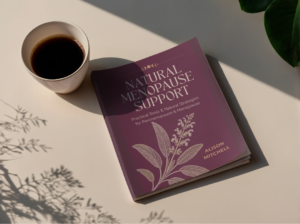
My book, Natural Menopause Support, walks through the physical changes of menopause and how to support your body through them naturally. It gives a thorough overview of the strategies available, with guidance on the why, when and how of using them. It’s available in paperback and Kindle.
If you’re in the perimenopause years, when your cycle starts doing unexpected things, The Cyclical Woman is a great place to start. It explores how hormones shape your mood, and how to work with their cyclical nature rather than against it.
A note on language: throughout this piece I use “women” and “she/her” for clarity of writing. Menopause is experienced by anyone born with ovaries, including trans men and non-binary people, and everything here applies to you too.